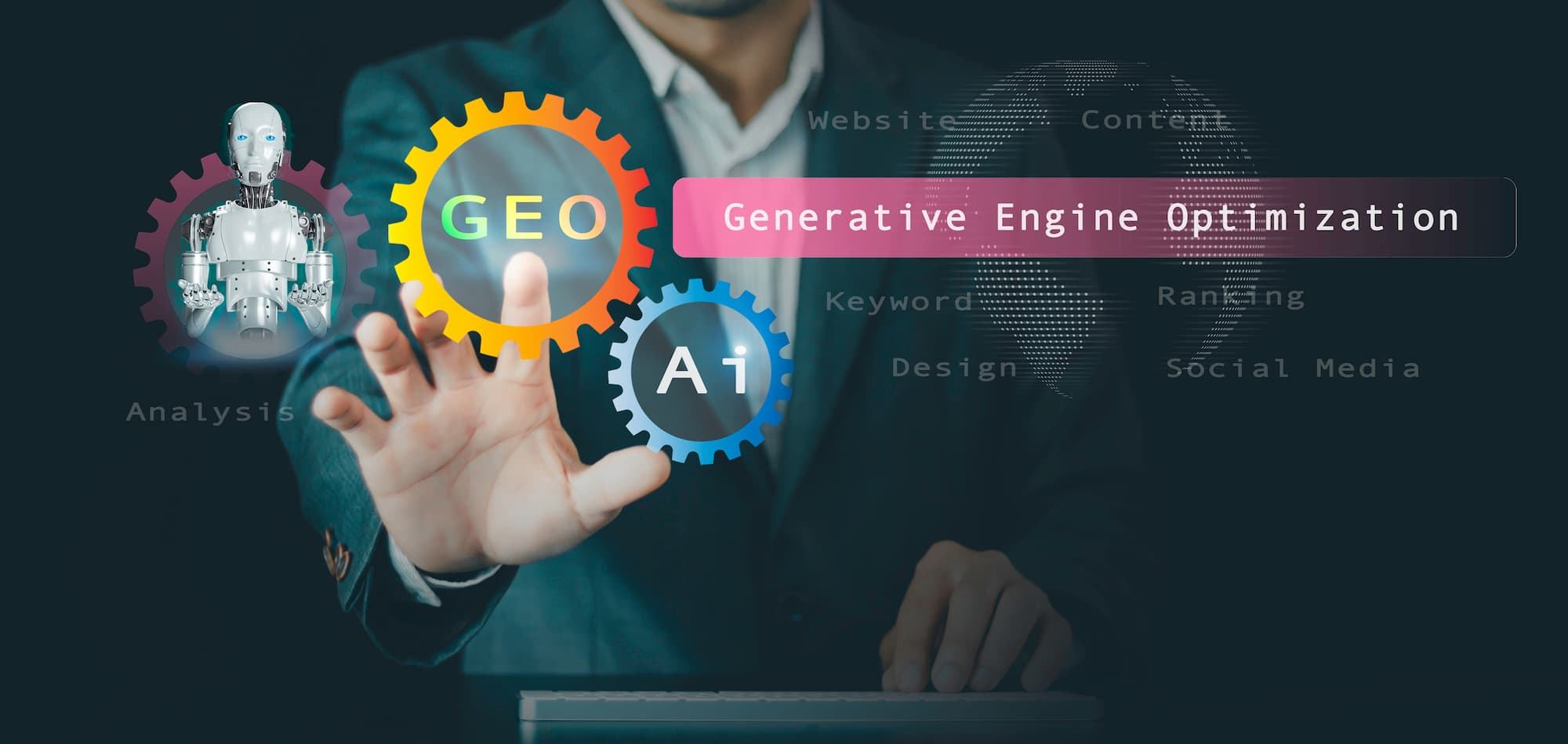
In the evolving ABCs and 123s of digital marketing, generative engine optimization, or GEO, is widely considered the next evolution of search , riding the wave of AI-driven search experiences. (See, we told you it was a lot of ABCs.)
GEO is one of the newest trends changing how we think about digital marketing. When people ask, “What is GEO?” or try to understand GEO in the context of digital marketing, they’re really asking how AI-driven answer tools change the way we show up online.
Does that mean search engine optimization (SEO) is dead? The short answer is no. Think of SEO as the engine that makes GEO work.
GEO is reshaping how people search, and with it how we, as marketers, should be approaching SEO. Let’s break down the following:
- What is GEO?
- What’s the difference between GEO and SEO?
- Why GEO is important.
- Key factors for GEO.
- Future of GEO.
What Is Generative Engine Optimization?
Generative engine optimization is the practice of structuring content so AI systems (think ChatGPT, Perplexity, Gemini, Copilot, Google’s AI Overview) can easily lift, verify and cite your brand inside the answers they serve you. Instead of a traditional results page with a list of links, these tools scan the web with their large language models (LLMs) to find concise, verifiable content that cleanly answers a user’s question. They then pull pieces of that content straight into an answer for you, as the searcher, to quickly peruse.
Those LLMs we mention (again with the letters) favor verifiable content with clear definitions, concrete facts (numbers and dates) and source signals like author, “updated” lines and organization details. Sound familiar?
In other words, many of the foundational best practices we already use for SEO are being repackaged and extended for GEO. An important thing to keep in mind is that a citation from ChatGPT or the other assistants is what we call zero-click visibility. Your brand shows up in the answer itself, even if the user never taps through to your site. These models are built to answer first. As a result, Search Engine Land reports 60% of Google searches on mobile now end without a click, which contributes to declines in traditional website performance metrics like click-through rate (CTR). That’s why it’s so important to understand the different goals of SEO and GEO when you review your analytics.
With SEO, marketing is aimed toward ranking on a search engine results page. We want to win those top spots and earn clicks.
With GEO, marketing is trying to “earn” in answer mentions and citations inside AI-generated responses that build recall, trust and assisted conversions. You are still present in the journey, but the touchpoint looks different.
GEO vs. SEO: Where They Overlap and Where They Don’t
To answer the big question: GEO is not replacing SEO; it is extending it. When people search for what GEO is or dive into GEO-SEO discussions, what they are really asking is how AI assistants and traditional search can work together instead of pulling in opposite directions. You still need the SEO fundamentals as part of a strong digital marketing strategy, but GEO tactics should also be layered in so assistants can scan, verify and cite your pages.
So what exactly should we still be doing on the SEO front that overlaps with GEO? For some, this might be a refresher, but to those unfamiliar, these SEO best practices lay the groundwork for GEO:
- User experience: Clear headings, logical structure and easy-to-read, plain language.
- Technical optimization: Pages that are crawlable/indexable, mobile-friendly and fast-loading.
- Relevant, high-quality content: Content that matches user intent, provides concrete details, aligns with E-E-A-T (experience, expertise, authoritativeness, trustworthiness) and stays up to date.
- Keyword research: Research into keywords to increase visibility and relevance to match users’ intent.
If you are already doing these things — and lucky for you, if you’re working with Angell Marketing, we’ve got you covered — you are not starting at ground zero for GEO. You are simply adjusting how you package the content, so an AI assistant sees your page as a clean, confident source. If you’re not working with a digital firm and have questions, reach out!
Now, here is where GEO starts to differ from SEO.
With SEO, the goal is to rank on the search engine results page and earn clicks to your site. With GEO, the goal is to earn in answer mentions and citations inside AI-generated responses, even if someone never clicks through.
A few key differences to keep in mind:
- SEO is centered on search engines and results pages, while GEO also looks at how assistants like ChatGPT, Perplexity, Gemini, Copilot and AI Overview surface answers.
- SEO success is usually measured with rankings, clicks and organic sessions. GEO often shows up in zero-click moments, more branded search later and warmer, more informed leads.
- SEO content can cover topics more broadly, while GEO pushes you to structure content as direct answers to specific questions with clear headings, FAQs and strong source signals.
Together, they work toward the same goal: helping people find you and trust you. But the way “winning” looks on each front is a little different. Working with a trusted marketing partner like Angell is key to ensuring your digital strategies are strong.
Why GEO Is Important
GEO is important because of the changes we see happening in search behavior.
People Are Asking Longer, More Natural-Sounding Questions
Instead of using “senior living Phoenix,” we might now see search queries that look like, “What are good independent living communities in Phoenix that can support my mom?”
Straight To the Point
The way AI Overview works when a user makes a search query is that the answers typically appear before a list of links points toward content. A searcher may skim through the answer and glance at one or two citations before moving on. If your brand doesn’t appear in that early window, you lose a chance to be an early touchpoint.
Zero-Click Moments Still Build Memory
Despite there being no click to measure, repeated mentions across answers builds familiarity. Over time, that familiarity can make a future request to tour, call or form-fill more likely. In layman’s terms, GEO is helping you market to prospects at the top of the funnel and still in the discovery phase.
For important life decisions, such as senior living, those early, repeated touches create a powerful impact on creating a lead. People lean on answers, reassurance and clarity for these decisions. GEO helps offer all three, paving the way for people when they’re asking for information.
Key Factors for GEO
So, what can you do to support GEO efforts?
Write in Focused Sections; Answer Specific Questions
AI likes clean structure. This can be achieved by breaking long content into short paragraphs, bullet points and subheads that directly address specific questions. This makes it easier for readers and the AI model to scan, understand and pull the right snippets into a direct answer.
Include Concrete Facts and Statistics
GEO rewards web pages that include hard facts: numbers, statistics, locations and qualifiers. Instead of saying, “We offer a variety of floor plans,” we would say, “Choose from studio, one-bedroom and two-bedroom apartment homes in Phoenix, AZ.” The more specific your content is, the easier it is to verify and cite.
Some bonus points are earned by adding structured data (schema markup) to website HTML with this kind of information. It can turn your content into rich snippets on the search engine results page, giving both searchers and AI models a quick, visual way to understand key details.
Cover Follow-Up Questions in the Same Place
Think of it as building a mini guide around a single topic, instead of scattering answers across multiple short pages. When people research, their questions usually build on each other. For example, it can start with, “How much does independent living cost in Phoenix?” with their next question potentially being, “What’s included in the monthly fee?” or, “What are some signs that my mom is ready for senior living?”
These kinds of questions can live on a content post or a service page that includes an FAQ. Then, use strong internal linking to credible, detailed pages (pricing, services, care levels) so both visitors and AI assistants see how everything connects and where to go for more details.
Keep Pages Fresh and Consistent
Like SEO, GEO isn’t a set-it-and-forget-it project. It’s important to refresh key pages with up-to-date information, whether that is pricing, services or amenity changes. Make sure information is consistent with your Google Business Profile and other platforms your brand may be on, such as YouTube or Facebook. Consistency across channels helps both humans and AI connect the dots.
This cross-channel alignment matters because GEO also benefits from citations across multiple domains. Recent research from Ahrefs shows that platforms like YouTube and Reddit are among the most frequently cited domains in AI assistant answers. When your brand is present, accurate and consistent across multiple channels, you strengthen the signals that you’re a trusted source.
When you put these factors together, you are making it very easy for AI assistants to recognize and evaluate your information as coming from a senior living community with clear, detailed, up-to-date answers. All crucial factors in helping you win in search.
The Future of GEO
The future of GEO is wide open. As technology advances and AI becomes part of everyday life, its role in how we search and make decisions will only grow.
AI Assistants Are Becoming the New Homepage for Questions
With more people adopting AI, we have seen a significant jump in the number of users doing research in AI tools versus the traditional search bar. Not only that, but AI Overview has also led to a drop of 34.5% lower average clickthrough rate for top-ranking pages, compared to similar informational keywords without an AI Overview. That means the first impression your brand makes could be in an answer box, not directly on your website.
GEO helps you show up in that space with clear, trustworthy answers, so your brand is still part of that first moment of discovery.
Local and Niche Questions Will Keep Growing
Because questions and prompts in AI tools are conversational in nature, we’ll see long-tail queries appear more often. Some examples of that are: “Best senior living communities near Phoenix that offer memory care and robust activities” or, “Senior living communities in Chicago that support couples with different care needs.”
That makes it crucial for brands to create content tailored to these specific questions, not just broad topics. With thoughtful keyword research and pages built around real queries like these, you gain an advantage in GEO by giving AI assistants exactly the kind of clear, detailed answers they’re looking to cite.
Measurement Will Look Different
Since there is no direct way to track GEO traffic yet, it remains difficult to clearly capture it in your analytics or connect it directly to specific efforts. On top of that, many GEO moments are zero-click interactions where people see your brand cited in an answer but never actually visit your site, so those touches will not appear as traditional sessions or page views.
That’s why GEO success often shows up in blended metrics like branded search growth, more informed leads and shorter paths from first touch to tour or call. And, like all of your marketing tactics, it works in tandem with other efforts and across strategies.
GEO, SEO and Content Strategy Will Blend
GEO won’t live in a silo. Proper GEO requires strong groundwork in both content strategy and SEO. Because AI citations are looking at content from multimodal search, it becomes important that brands show up in multiple formats, text, images, video and more to stay visible in today’s search landscape.
The future means doing less of GEO as a separate task, and more of creating content that works for search engines, AI assistants and human searchers all at once. The goal is not to over-optimize content and pages for AI at the expense of humans. If a page is easy for a real person to read and understand, you are moving in the right direction for GEO, too.
Bringing GEO Into Your Current Strategy
If you’re already investing in SEO, the good news is you’re not starting from scratch. If your team is ready to talk about how GEO and SEO can support your senior living marketing, get in touch with us. We want your prospects to recognize your name when they see it in an answer, feel confident when they click through, and feel just a little more at ease as they move toward a tour or a call.
Featured Image: CHIEW / Shutterstock